
Hiring A Squarespace Designer or Building with AI?
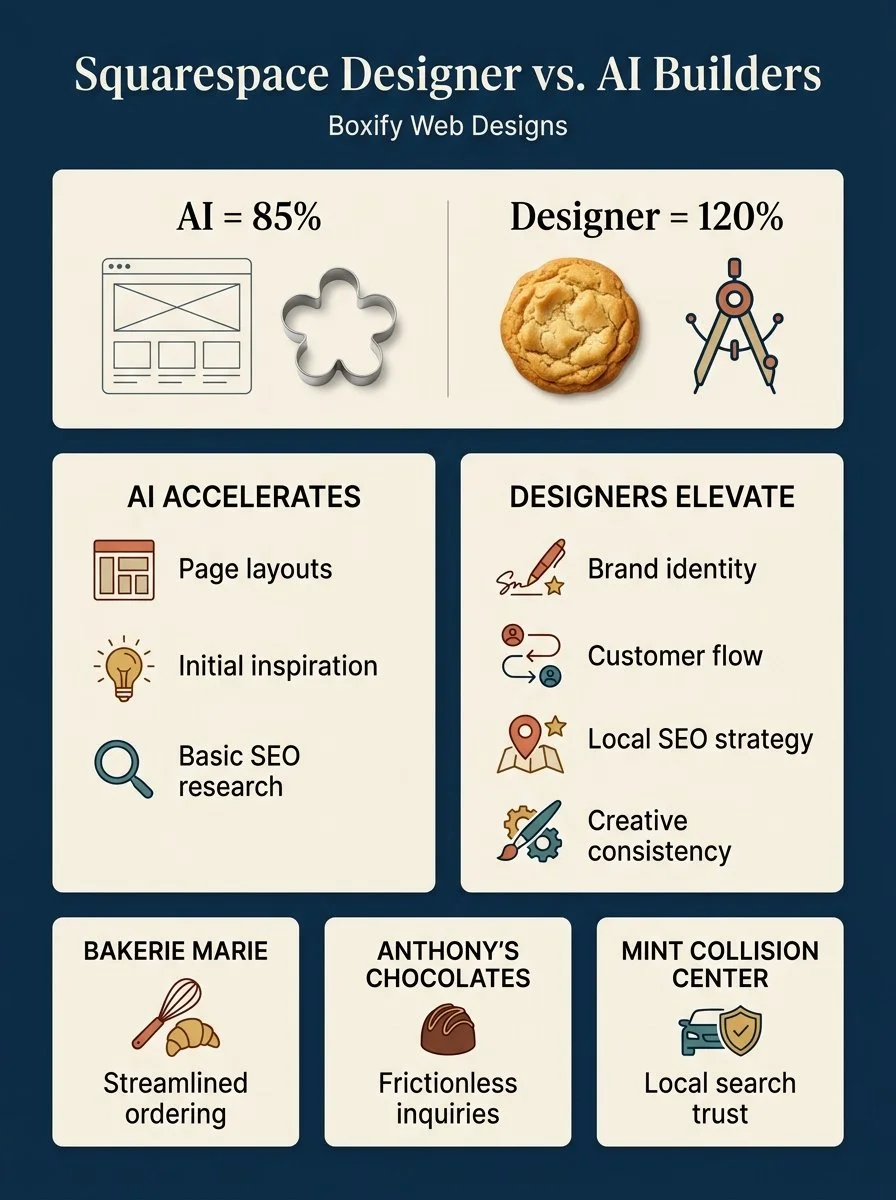
Editorial infographic by Boxify Web Designs titled "Squarespace Designer vs. AI Builders," contrasting AI's 85% starting point (cookie cutter analogy) with a designer's 120% execution (finished cookie and creative direction), comparing what AI accelerates versus what designers elevate, and highlighting Bakerie Marie, Anthony's Chocolates, and Mint Collision Center.
Artificial intelligence is changing the way websites are designed, developed, and managed. Tools like ChatGPT, Claude, Lovable, and Vercel have made it easier than ever to generate website layouts, write content, create designs, and even build functional website prototypes.
But can AI replace a dedicated Squarespace website designer?
At Boxify Web Designs, our answer is no. And that doesn't mean we don't believe in AI. In fact, we use AI throughout our own creative process.
The difference is understanding what AI does well, where it falls short, and what human experience brings to a website that technology alone cannot replicate.
With more than 15 years of experience in website design, branding, and digital marketing, we believe the best websites come from combining the speed of AI with the creativity, strategic thinking, and personal attention of an experienced designer.
Let's explain why.
TLDR: Is Hiring a Squarespace Designer Better Than Using AI?
AI can build website layouts, generate content, suggest branding ideas, and accelerate research. But building a website that genuinely represents your business requires more than prompts and automation.
At Boxify Web Designs, we use AI to improve our creative process, not replace it. Our experience with businesses like Bakerie Marie, Anthony's Chocolates, and Mint Collision Center demonstrates why every business needs a different approach to design, functionality, branding, and SEO.
AI provides the starting point. A professional Squarespace designer brings the strategy, originality, consistency, and human understanding that turn a website into a business asset.
Our philosophy is simple: AI gets you 85% of the way there. Experience and expertise take it to 120%.
What AI Does Really Well Compared to a Squarespace Designer
1. AI Can Structure Your Squarespace Website
One of the biggest advantages of AI is speed.
AI can generate website outlines, suggest page layouts, organize information, write initial content, and recommend sections that visitors might expect to find.
For example, when building a website for a bakery, AI can quickly suggest a homepage, menu, ordering page, about page, gallery, and contact page. It can even generate ideas for how those pages should be organized.
What might take a designer several hours of initial research and brainstorming can sometimes be completed in minutes with AI.
That's a significant advantage.
However, knowing what pages a bakery website should have is very different from understanding how a particular bakery operates, what makes its products special, and how customers actually place orders.
AI gives us a starting point. Our job is to make that starting point work for the actual business.
2. AI Can Generate Branding and Design Inspiration
Another area where AI excels is creative exploration.
As designers, we work with business owners who have very different personalities and visions. Some come to us with a complete picture of what they want. Others are looking for guidance, inspiration, and creative direction.
AI can help us explore color palettes, typography, visual styles, branding concepts, page layouts, and different ways to present information.
Sometimes it even suggests an idea we hadn't considered.
We use these ideas to challenge our original thinking and explore possibilities. We don't simply accept everything AI generates. We evaluate the suggestions, make adjustments, and incorporate what makes sense for the client's brand.
In many ways, AI makes us better designers because it gives us more ideas to work with.
3. AI Can Accelerate Research and SEO Planning
AI is also incredibly useful when researching an industry, identifying common customer questions, brainstorming keywords, and organizing website content.
For example, a collision center and a bakery have completely different audiences and search intentions.
Someone looking for collision repair wants to understand services, insurance assistance, turnaround times, and whether the shop is trustworthy.
Someone looking for a bakery might want to see product photos, menus, pricing, ordering instructions, and pickup availability.
AI can help us identify these differences and build an initial content strategy.
But research is only the beginning. A professional still needs to verify information, understand search intent, evaluate competitors, and create content that offers something genuinely useful.
Our Analogy: AI Gets You 85% of the Way There. We Take It to 120%.
The way I explain our approach to clients is simple:
"AI gets you about 85% of the way there. We take it to 120% after experience, thought, and expertise take a deeper look."
Think about baking a cookie.
AI is the cookie cutter. It gives you a shape, a starting point, and a consistent structure.
But who chooses the ingredients? Who determines the flavor? Who adjusts the recipe, monitors the baking process, and makes sure the final product comes out perfectly golden?
That's where experience matters.
You can have the right shape and still end up with a cookie that tastes like nothing special.
A website works the same way. Having the right pages, colors, and layout doesn't automatically create a website that represents your business or convinces someone to become a customer.
Harry Harout Gagulyan, CMO of Boxify Web Designs
Where AI Falls Short and Why a Squarespace Designer Still Matters
We've experimented with several AI platforms and design tools, including ChatGPT, Claude, Lovable, and Vercel's AI-powered development tools.
We've seen some impressive results. Some features are genuinely useful, particularly when generating initial layouts, brainstorming content, and exploring different design directions.
But we've also noticed some consistent shortcomings.
Generic headlines and taglines: AI often produces polished but predictable language that could describe almost any business.
Repetitive designs: When prompts lack detailed business information, the results can look remarkably similar to other AI-generated websites.
Missing information: AI may leave out important business details unless you know exactly what questions to ask.
Inconsistent creative direction: As you revise and expand a website, the design, tone, and personality can drift.
Fact-checking: AI can confidently provide inaccurate information, so research and verification are essential.
Limited business understanding: AI only knows what you provide and what it can reliably establish through its available information.
That last point is especially important.
Most business owners aren't professional website designers. They might not know what information is missing, what functionality they need, or what questions customers will ask before making a purchase.
A professional designer helps identify those gaps.
Generic AI Websites Versus Original Website Design
One of the biggest problems we encounter with AI-generated designs is how easily they can start looking alike.
The same polished layouts, familiar headlines, predictable color combinations, and stock-style presentation can make one website blend into another.
That's not to say AI cannot produce original designs. It absolutely can. But the quality of the result depends heavily on the direction, information, and creative decisions behind it.
Consider the difference between a premium chocolatier and a neighborhood bakery.
A premium chocolatier might need a refined presentation with rich colors, elegant typography, and detailed product photography.
A neighborhood bakery might benefit from something warmer, more inviting, and personal, where visitors immediately feel connected to the products and the person making them.
Both businesses sell food, but they shouldn't necessarily look or communicate the same way.
A Squarespace designer can make those distinctions and carry them throughout the website, from the homepage to the smallest details like icons, buttons, hover effects, and navigation.
Those details help establish a recognizable brand identity.
Real Examples: How We Approach Different Businesses
At Boxify Web Designs, our work with clients demonstrates why understanding the business is just as important as understanding website design.
Here are three examples.
Bakerie Marie: Building a Website Around How Customers Order
A bakery isn't just about displaying beautiful pictures of cookies and baked goods.
Customers need to understand what's available, how to order, what options exist, and how to arrange pickup or delivery.
With Bakerie Marie, we focused on creating a recognizable brand, presenting the products professionally, and developing a more organized ordering experience using Squarespace and custom form functionality.
The objective wasn't simply to make a pretty bakery website. It was to give customers a straightforward way to explore products and submit orders.
That requires thinking about the actual customer journey, not just generating a homepage layout.
Anthony's Chocolates: Turning Social Media Interest Into Customer Inquiries
Anthony's Chocolates presented a different challenge.
As a small-batch chocolatier, the business had developed an audience through Instagram and local pop-ups. However, relying heavily on Instagram messages for customer inquiries and orders created unnecessary friction.
Customers needed a more organized way to learn about the chocolates, explore the products, and get in touch.
We worked on a website experience that gave the brand a more professional online presence and helped create a clearer path for customer inquiries.
The design needed to communicate the premium nature of the products while making the experience simple for someone who wanted to purchase or ask a question.
AI can certainly suggest a chocolate website layout. But understanding the challenges of a small-batch food business and how its customers interact with the brand is where the Squarespace designer adds value.
Mint Collision Center: Designing for Trust, Local Visibility, and Leads
Now let's look at something completely different.
Mint Collision Center is an automotive collision repair business in Chatsworth, California.
Unlike a bakery or chocolatier, its customers aren't necessarily browsing for enjoyment. They're often looking for help after an accident and need to find a reliable repair facility.
The website needed to communicate services, establish credibility, answer customer questions, and make it easy for visitors to contact the business.
We worked on the website architecture, service-specific pages, testimonials, local SEO content, and functionality such as live chat and information about 24-hour towing.
The result extended beyond appearance. Our published case study reports that Mint Collision Center reached #1 on Google for targeted local searches such as "Auto Body Shop near Chatsworth" within six months.
That outcome came from understanding the industry, building relevant website content, and developing a broader local visibility strategy.
A generic AI-generated collision center website might look professional. But would it know which services customers search for, what information establishes trust, or how to structure the pages around local search intent?
That's the difference between generating a website and developing a website strategy.
Inconsistent Design and Creative Direction With AI
Another challenge we've experienced is maintaining a consistent creative vision.
When a professional designer takes on a project, there is an overall direction that guides the website. Colors, typography, language, imagery, and page layouts all work together to create a recognizable identity.
With AI, that consistency can become difficult to maintain.
You might ask for a more creative homepage, then request changes to the service page, and suddenly the tone, visual direction, or personality starts to change.
Sometimes AI generates something that looks impressive but doesn't quite follow the original vision.
These subtle differences matter.
A professional Squarespace designer acts as the creative director throughout the project. Every revision is evaluated against the original brand direction and the client's goals.
The objective isn't to make each individual page look impressive. It's to make the entire website feel like one cohesive business.
The Human Connection: Working With a Squarespace Designer
There is another part of website design that often gets overlooked: the experience of working with another person.
Business owners aren't simply buying a website. They're trusting someone to understand their business, their customers, and the reputation they've spent years building.
At Boxify Web Designs, we take the time to ask questions that go beyond the initial website request.
What are your future plans? What makes your business different? What do your customers appreciate most? What problems do they encounter? What do you want people to remember after visiting your website?
These conversations matter.
Sometimes a client has an idea that needs refining. Other times, a casual conversation leads to an entirely different direction that makes more sense for the business.
AI can provide suggestions, but it doesn't replace the collaboration, shared understanding, accountability, and personal connection that come from working directly with an experienced designer.
And let's be honest. Sometimes an awkward joke, a shared interest, or a conversation about something completely unrelated to the website makes the entire working relationship better.
That human connection is part of the creative process.
So, Should You Hire a Squarespace Designer or Use AI?
Our recommendation is to use both, but understand what each one brings to the table.
AI is an incredible resource. It can accelerate research, generate ideas, explore layouts, and help designers work more efficiently.
However, a successful business website needs more than a collection of generated pages.
It needs a clear message, an understanding of the customer, thoughtful branding, consistent design, appropriate functionality, and a strategy for converting visitors into customers.
Most importantly, it needs to represent the people behind the business.
You are the expert on your business. You know your customers, the questions they ask, what makes them choose you, and what separates you from competitors.
A professional Squarespace designer brings those details together and turns them into a website that communicates your value.
At Boxify Web Designs, we don't see AI as our competition. We see it as another tool that helps us deliver better work.
AI can help build your website. We help build the website your business actually needs.
Contact Boxify Web Designs to discuss your project and get a website designed around your business, your customers, and your goals.